Thursday, February 21, 2013
Wandering Monsters for Bestiary 1
PDF version available HERE
I've been using the Pathfinder Bestiary in my DCC games lately. I'm pretty comfortable with the PF stat blocks, and tweaking on the fly, so it works well for me. I made some wandering monster tables for it, and decided to post them for grins. The number encountered is in brackets, and it should be readily apparent that the page number is in parentheses
If you want to get really fancy, you can use the following method for the dungeon tables:
Roll a d6 along with the d12. If the d6 comes up 1 or 6, look the monster up one table lower or higher, respectively.
Dungeon Level 1-3
1. Monitor Lizards [1-4] (p.194)
2. Giant Centipedes [3-6] (p.43)
3. Fire Beetles [7-12] (p.33)
4. Ghouls [2-5] (p.146)
5. Vargouille [1] (p.272)
6. Skeletal Champion [1] (p.252)
7. Cloaker [1] (p.47)
8. Darkmantle [1-6] (p.55)
9. Wight [1-2] (p.276)
10. Bat Swarm [1] (p.30)
11. Dretches [1-2] (p.60)
12. Goblin Dogs [1-8] (p.157)
Dungeon Level 4-6
1. Gibbering Mouther [1] (p.153)
2. Centipede Swarm [1-2] (p.43)
3. Ghost [1] (p.144)
4. Yeth Hounds [2-7] (p.286)
5. Troll [1] (p.268)
6. Greater Barghest [1] (p.27)
7. Vampire [1] (p.270)
8. Chokers [1-8] (p.45)
9. Black Pudding [1] (p.35)
10. Gorgon [1] (p.165)
11. Gray Ooze [1] (p.166)
12. Rust Monsters [2-5] (p.238)
Dungeon Level 7-9
1. Girallons [5-8] (p.154)
2. Iron Golem [1] (p.162)
3. Half-Fiend Minotaurs [3-6] (p.171)
4. Hell Hounds [3-12] or Nessian Hell Hound [1] (p.173)
5. Intellect Devourers [1-6] (p.180)
6. Kytons [3-6] (p.185)
7. Driders [1-6] (p.113)
8. Elder Earth Elemental [1] (p.123)
9. Bebilith [1] (p.32)
10. Rakshasa [1] (p.231)
11. Shadow Demons [1-2] (p.67)
12. Night Hag [1] (p.215)
Dungeon Level 10+
1. Neothelid [1] (p.214)
2. Xill [2-12] (p.283)
3. Horned Devil [1] (p.76)
4. Devourer [1] (p.82)
5. Tarrasque [1] (p.262)
6. Purple Worm [1] (p. 230)
7. Nalfeshnee [1] (p.65)
8. Greater Shadows [3-6] (p.245)
9. Medusa [1] (p.201)
10. Shoggoth [1] (p.249)
11. Elder Fire Elemental [1-3] (p.125)
12. Astral Deva [1] (p.10)
Plains
1. Giant Ants [1-10] (p.16)
2. Giant Wasps [3-6] or Wasp Swarm [1] (p.275)
3. Ankhegs [1-4] (p.15)
4. Bugbears [1-10] (p.38)
5. Cheetahs [1-4] (p.40)
6. Chimera [1] (p.44)
7. Cockatrice [1-12] (p.48)
8. Cyclops [1-6] (p.52)
9. Triceratops [1] (p.86)
10. Gnolls [1-20] (p.155)
11. Aurochs [3-30] (p.174)
12. Manticore [1] (p.199)
Hills
1. Bulette [1] (p.39)
2. Giant Ants [2-20] (p.16)
3. Giant Stag Beetle [1-6] (p.33)
4. Chimera [1] (p.44)
5. Wyvern [1-2] (p.282)
6. Ettin [1-2] (p.130)
7. Griffons [1-10] (p.168)
8. Hill Giants [2-5] (p.150)
9. Ogres [1-4] (p.220)
10. Phase Spiders [3-6] (p.226)
11. Dust Mephits [3-6] (p.202)
12. Bandits [2-20] (p.264)
Forest
1. Wolves [1-12] or Dire Wolves [3-8] (p.278)
2. Treant [1] (p.266)
3. Unicorn [1] (p.269)
4. Grizzly Bears [1-2] (p.31)
5. Boars (1:6 chance Dire) [1-8] (p.36)
6. Centaurs [3-10] (p.42)
7. Dryad [1] (p.116)
8. Ettercaps [3-8] (p.129)
9. Owlbears [1-6] (p.224)
10. Pseudodragon [1] (p.229)
11. Satyrs [3-6] (p.241)
12. Elves [3-30] (p.114)
Mountains
1. Stone Giants [1-8] (p.151)
2. Tengu [3-12] (p.263)
3. Stone Golem [1] (p.163)
4. Duergar [3-30] (p.117)
5. Huge Air Elemental [1-2] (p.120)
6. Shadow Demons [1-3] (p.67)
7. Rocs [1-2] (p.236)
8. Salamanders [2-5] (p.240)
9. Medium Earth Elementals [2-7] (p.122)
10. Wyverns [1-3] (p.282)
11. Crag Linnorm [1] (p.190)
12. Red Dragon (d6: 1-3=young, 4-5=adult, 6=ancient) [1] (p.98-99)
Swamp
1. Constrictor Snakes [1-6] (p.255)
2. Giant or Poisonous Frogs [3-12] (p.135)
3. Will-O-Wisps [1-4] (p.277)
4. Boggards [1-12] (p.37)
5. Shocker Lizards [1-12] (p.248)
6. Basilisk [1-2] (p.29)
7. Chuul [1-4] (p.46)
8. Crocodiles (2:6 chance Dire) [1-6] (p.51)
9. Dracolisks [1-2] (p.170)
10. Green Hags [3] (p.167)
11. Harpies [3-12] (p.172)
12. Froghemoth [1] (p.136)
Jungle
1. Giant Flytrap [1-2] (p.134)
2. Gorillas (3:6 chance Dire) [1-12] (p.17)
3. Army Ant Swarm [1] (p.16)
4. Boars (4:6 chance Dire) [1-8] (p.36)
5. Dire Lions [3-8] (p.193)
6. Tyrannosaurus [1] (p.86)
7. Giant Mantis [1-10] (p.200)
8. Giant Frilled Lizards [1-8] (p.194)
9. Vegepygmies [3-30 plus chieftain] (p.273)
10. Assassin Vines [3-6] (p.22)
11. Zombies [2-20] (p.288)
12. Spider Swarms [2-5] (p.258)
Tundra
1. Winter Wolves [6-11] (p.280)
2. Yeti [1-8] (p.287)
3. Dire Wolverines [1-2] (p.279)
4. Frost Giants [2-5] (p.149)
5. Ice Golems [1-4] (p.161)
6. Ice Linnorm [1] (p.191)
7. Remorhaz [1] (p.233)
8. Ice Devil [1] (p.77)
9. Ice Elves [2-200] (p.114)
10. Dire Polar Bears [1-4] (p.31)
11. Ice Mephits [3-6] (p.202)
12. White Dragon (d6: 1-3=young, 4-5=adult, 6=ancient) [1] (p.100-101)
Desert
1. Behir [1-2] (p.34)
2. Bebilith [1] (p.32)
3. Couatl [1-2] (p.49)
4. Lamias [1-8] (p.186)
5. Efreeti [1] (p.140)
6. Vrocks [1-6] (p.69)
7. Bone Devil [1] (p.74)
8. Giant Scorpions [1-10] (p.242)
9. Sphinx [1] (p.257)
10. Sand Worm [1] (p.230)
11. Phoenix [1] (p.227)
12. Blue Dragon (d6: 1-3=young, 4-5=adult, 6=ancient) [1] (p.94-95)
Underdark
1. Giant Slug [1] (p.254)
2. Violet Fungus [3-12] (p.274)
3. Xorn [1-6] (p.284)
4. Yellow Musk Creeper + 1-6 Yellow Musk Zombies (p.285)
5. Troglodytes [3-30] (p.267)
6. Basidironds [1-12] (p.28)
7. Aboleths [1-6] (p.8)
8. Cave Fishers [1-6] (p.41)
9. Derro [3-30] (p.70)
10. Mites [2-200] (p.207)
11. Ropers [1-6] (p.237)
12. Shoggoth [1] (p.249)
Some day I'd like to make versions for the Bestiaries 2 and 3 as well, but even if I do, I'm probably not going to do those links again, because man that was a pain in the buns!
Monday, February 11, 2013
Gamma-RIFT-Critical-Future Crawl Classics
There is some development of a Gamma World hack of DCC RPG going on over at the G+ community Gamma Crawl Classics. They are doing some good work over there, but with so many cooks in the kitchen, it's bound to take some time. Plus, I think they are trying to make a complete standalone thing, so there's a lot of work involved there.
Interestingly enough, the two games I'm currently running are DCC RPG, and Gamma World (first edition). In both games I borrow heavily from other game books, so I'm pretty comfortable with mashing a bunch of stuff together. I thought the project was very neat, so I decided to cobble something together real quick for anyone that might be saying to themselves, "That's awesome, but I want to play it NOW!"
Without further ado, I present you with Gamma-RIFT-Critical-Future Crawl Classics (or GRCFCC for short).
Required Materials
- Mutant Future (get it free here)
Use it for poison class table (p. 50), radiation class table (p. 51), monsters, equipment, artifacts. - Encounter Critical (get it free here)
Use it for its many lovely charts, the warlock spells, and the monster listing. - DCC RPG Reference Sheets (here)
Use it for crit tables, medieval-style equipment, adjudicating combat stunts via the mighty deeds tables, corruptions, etc.
- Gamma World. I like some of the charts from 1E Gamma World, like the esoteric weapon class vs. armor class table, and the poison and radiation tables. These are unnecessary, but nice to have.
- Full DCC RPG Rulebook. You may want to use other stuff from DCC like spells and whathaveyou.
- RIFTS. Great setting inspiration and lots of fun equipment, cybernetic/bionic upgrades, and so forth.
- Carcosa. More mutations, robot generator, and a great hexcrawling resource.
- Booty and the Beasts. An amazing one-stop shop for monsters and treasures. Most monsters have a ton of hit dice, so they work great for this sort of game.
- TMNT and Other Strangeness. This book has some great random animal tables in case you are interested in using that sort of thing. There is also a few interesting pieces of equipment, and a nice selection of NPCs which you can use to build adventures around.
The seven attributes are rolled 4d6 drop lowest, in order. If you get an 18, roll percentile dice.
ATTRIBUTE TABLE
Score Modifier Die Type
3 -3 d2
4-5 -2 d3
6-8 -1 d4
9-12 -- d6
13-15 +1 d8
16-17 +2 d10
18/01-50 +3 d12
18/51-75 +4 d14
18/76-90 +5 d16
18/91-95 +6 d20
18/96-99 +7 d24
18/00 +8 d30
The Seven Attributes and some of their uses:
- Strength [STR]:
Add die type to physical damage rolls. Die type is used by itself for unarmed damage rolls. - Dexterity [DEX]:
Die type is your attack bonus die in physical combat. Modifier does not affect AC. However, unarmored characters may use their DEX score as their armor class. - Constitution [CON]:
Score indicates number of d6 hit dice rolled. - Psychic Power [PSY]:
Add die type to mental attacks. Add modifier to PSY score to get mental defense rating (I know, it's weird). - Intelligence [INT]:
Influences ability to figure out tech artifacts, and determines spell capacity for PSH wizards. - Charisma [CHA]:
Modifier affects NPC Reactions and number of followers. (Base number of followers is 4.) - Luck [LK]:
Die type is the "crit die" that is rolled whenever a critical hit is scored.
CHARACTER TYPES
Players may choose to play a pure strain human (warrior or wizard sub-type) or a mutant.
Pure Strain Human
Choose One:
- Wasteland Warrior
+3 to STR/CON/CHA and add CON score to hit point total. Score crit on 19-20. - Gamma Wizard
+3 to INT/CHA, and the ability to cast one spell per point of INT above 12.
Mutant
Player may choose if the character is a humanoid (mutated human) or an animal-based mutant. Details should be worked out with the GM.
1d4 randomly-determined physical mutations
1d4 randomly-determined mental mutations
(Mutant Future mutation chart recommended, since it's both comprehensive and free.)
ADVANCEMENT
Use any XP system you like (such as the one in Mutant Future). Personally I just give a level and a roll on the table to each surviving character at the end of each session. I might be inclined to grant a bonus roll for completion of an important goal, or playing in a particularly clever and entertaining way. If an attribute score is already 18/XX, and you get a +1 to that ability, you get to reroll your percentile dice and take the new result if it is higher. If the roll is lower, just keep what you currently have.
Roll d8 at each level gain:
- +1 STR
- +1 DEX
- +1 CON
- +1 PSY
- +1 INT
- +1 CHA
- +1 LK
- Player choice
- Attribute Scores do not increase beyond 18. If a player already has an 18, and they get something that increases the score, they may roll percentile dice again to see if they get a higher number. If they roll lower, the score stays the same.
- Attack Bonus Die: In most circumstances, it's the DEX die that you are rolling with your attacks. However, in some cases, the STR die might be more appropriate - especially when attempting a STR-based combat stunt like a body slam or something. Also, if you want to add another twist, use the Luck die for attacks with energy weapons. If the Luck die comes up 1, that's when you can have them run out of ammo/batteries/gun explodes/whatever.
- Saving Throws: There are no base save bonuses by class as there are in some other games. If the referee determines a character is entitled to a saving throw, the player rolls a d20 and adds the modifier from whatever attribute is most relevant (CON for poison/radiation, PSY for mind-affecting attacks or fear, DEX for dodging, LK if it doesn't fit anything else, etc.) Generally the target number to succeed is 15+, but the referee will let you know if it's something different.
- Combat Stunts: They work the same as DCC's "Mighty Deeds of Arms™", but a 4+ is required on the attack die rather than a 3+.
- Crit Tables: Gamma Wizards use Crit Table I. Mutants use Crit Table II. Wasteland Warriors use Crit Table III. There should probably be a separate crit table just for energy weapons, but I don't know of any off hand. Any suggestions?
- Burning Luck: Luck points may be permanently burned in order to add the die type (prior to burn) to any roll. All 18's become 17 when burned. Optionally, to encourage the burning of luck points, you may have everyone roll a d20 at the end of each session. If they roll over their luck score, they get to add a point to it.
- Mental Combat: Psychic attacks are made with the attacker rolling a d20 + their PSY die type against the defender's PSY score + PSY modifier. If you don't like that, just use the mental attack chart in Mutant Future (page 55), or whatever else you may fancy.
- Spells Known: PSH wizards know one spell per point of INT above 12. Print pages 20-21 from Encounter Critical and number the spells 1 through 16. Have the player roll a d16 as many times as they need to in order to determine the spells the wizard knows. Spells from any source may be used of course, but the EC ones are nice because they fit on one page and offer True Scientific Realism™. The player can just circle the ones they know, so it's easy as shit! Additional spells must be gained through adventuring (or cash payments to the GM).
- Spell Casting: Spells are cast much the same as in DCC. A spell check is made (1d20 + level + INT modifier). If using DCC spells, just go by the chart. If using the Encounter Critical spells, use this as a guideline: Natural 1 is a corruption. 2-9 is failure and loss of the spell. 10-11 is failure but spell not lost. 12+ is success, and the referee may grant improved effects for a high result. A natural 20 is a crit, and the LK die type may be rolled and added to the spell check result. If a save is allowed, the DC is equal to the spell check result. If you have no idea what I'm talking about, just make up your own system, but make sure to include something where the wizard can fumble a casting and have horrible shit happen to them.
- Tech Artifacts: If you don't have anything else, you can just use the artifact rules from Mutant Future. However, I'd recommend trying to get your hands on one of those fancy flowcharts from Gamma World or Expedition to the Barrier Peaks.
- Armor: We are using ascending AC here (unarmored = AC 10) so make whatever conversions are necessary. I recommend capping AC at 20 to keep things sensible.
- RIFTS Power Armors: These are cool as shit and you will eventually want them in your game. Problem is (for me at least) I have no fucking clue how to play RIFTS. No matter. Rather than introducing the complexity of mega-damage and all that other shit into your game, just assign each armor an AC bonus and some extra hit points that come off before the character's hit points. As a quick example I'd probably give Dead Boy armor like 50 hp and 18 AC, whereas Glitterboy armor would be 150 hp and 20 AC. I'm not claiming these numbers are any good. You'll just have to play it by ear and use your own good judgement.
- RIFTS Mega-damage Weapons: Pretty much same as above. Unless you want to deal with M.D.C., you just have to convert the damage to either a handful of d6's, or perhaps a number of d6's x 10. Whatever feels right to you at the time. Just make sure to write it down somewhere. (Yeah, right!)
- Zero-Level Play: If you want to replicate the character funnel from DCC, just have each player roll up a handful of characters. Instead of CON score x d6 for hit points, just have them use their CON score as their hp total. Give them each a knife, a bow and a few arrows, and one or two pieces of random mundane gear from the DCC equipment list. Send them off on an adventure, preferably somewhere that they can find lots of cool stuff and die trying to get it or figuring out how to use it. Survivors of the first adventure can roll hp using the normal method, and continue with further adventures.
Wednesday, February 6, 2013
Staff of the Insane Magician [DCC]
Here's a draft of an artifact item I'm working on. Enjoy!
Staff of the Insane Magician
This iron-shod black oaken staff is adorned with multi-colored ribbons and the tiny skulls of unidentifiable creatures. It deals 2d6 DARO* damage in melee combat, and can fire magical bolts of energy which automatically hit and deal 1d6+2 damage at-will. However, its true power lies in its ability to amplify the casting power of the user, and channel that power into the casting of a random magical spell. The caster first makes a spell check as normal, then rolls a die on the effect chart based on the result of the spell check (see below).
*DARO: "Doubles add and roll over" (see Tunnels & Trolls)
Spell Check Result Die to Roll on the Effect Chart
1 None. User suffers two greater corruptions
and staff loses all power except for its
melee combat ability.
2-9 d8
10-13 d10
14-17 d12
18-21 d14
22-25 d16
26-29 d20
30+ d24
Effect Chart
(all effects last 6 turns/1 hour unless otherwise specified)
Staff of the Insane Magician
This iron-shod black oaken staff is adorned with multi-colored ribbons and the tiny skulls of unidentifiable creatures. It deals 2d6 DARO* damage in melee combat, and can fire magical bolts of energy which automatically hit and deal 1d6+2 damage at-will. However, its true power lies in its ability to amplify the casting power of the user, and channel that power into the casting of a random magical spell. The caster first makes a spell check as normal, then rolls a die on the effect chart based on the result of the spell check (see below).
*DARO: "Doubles add and roll over" (see Tunnels & Trolls)
Spell Check Result Die to Roll on the Effect Chart
1 None. User suffers two greater corruptions
and staff loses all power except for its
melee combat ability.
2-9 d8
10-13 d10
14-17 d12
18-21 d14
22-25 d16
26-29 d20
30+ d24
Effect Chart
(all effects last 6 turns/1 hour unless otherwise specified)
- All surface areas (floors, walls, ceilings, etc.) within 100’ of the caster become covered in a 1”-thick sheet of ice. Anyone attempting to move at greater than ¼ speed - or doing anything else that could result in a loss of balance – must roll under half their agility score or fall prone.
- All creatures hostile to the caster within 100’ become illuminated in faerie fire. Attacks against such creatures are made at +2 and they have no hope of hiding, etc.
- The entire room the caster is in becomes filled with a thick, opaque smoke. Although perfectly breathable, everyone in the room is effectively blinded. If outdoors, the smoke covers a 100’ radius area around the caster, and clears in 2-8 rounds.
- 1d30 kobolds are summoned from the ether (2 hp, AC 12, Spear +0(1d4), +0 all saves). Roll 1d10. If the roll is equal or under the caster’s level, then the kobolds are bound to his every command. If the roll is failed, half the kobolds attack the caster while the other half attack his friends. The kobolds remain until destroyed.
- A random character or monster within 50’ of the caster (but not the caster himself) is permanently polymorphed into a cute fuzzy bunny rabbit. Roll 1d10+18 to determine the power of the spell for dispelling purposes.
- The staff becomes charged with 10d6 damage worth of fireballs. They may be fired by the wizard as a single 10d6 blast, two 5d6 fireballs, ten 1d6 mini-fireballs, or whatever. For each fireball launched, the caster makes a spell check. Targets that make a reflex save with DC equal to the spell check only take half damage.
- The caster (50%) or a random ally (50%) permanently becomes a skeleton, loses any existing racial abilities, but gains the following: a. Convert hit dice to d12
- The caster and his party are teleported to a random room in any dungeon that exists in the judge’s world. (Judge’s choice)
- Transmutation! All gold within 100’ of the caster is transformed. Roll 1d6: 1= lead; 2= copper; 3-4= silver; 5= electrum; 6= platinum. No experience is gained or lost due to this effect.
- Uber-Mensch! Caster grows to 150% size, and all abilities increase to 18 for 1d6+6 turns.
- Under-Mensch! Caster shrinks to 50% size, and all abilities decrease to 3 for 1d6+6 turns.
- Caster can fly for 6 turns.
- A djinni appears and offers to grant a single wish, but the wish must be made in 60 seconds real-time, or the djinni disappears. He is also a bastard and will screw over the caster in any way possible.
- 2d6 smiley-face cookies appear. Eating one grants a permanent +1 luck increase. They are very tasty as well.
- A powerful 2" thick stream of silly string spews forth from the staff for 1d6+6 rounds. The caster must spend his actions to brace the staff. If the staff is released, it will be propelled in a random direction at a speed of 60’ per round.
- All within 50’ of the caster must make a Will save or become confused for 1d20 rounds. Caster makes a spell check to determine save DC. Each round a PC/creature is confused, roll a d4: 1= act normally; 2= babble incoherently; 3= attack nearest living thing; 4= attack self.
- The staff emits strong gamma rays for a few moments. All within 50’ must make a DC 20 Fort save or suffer a random permanent mutation. Use whatever mutation chart you have handy – Mutant Future, Carcosa, Encounter Critical, or whatever.
- A yes-man appears, showering the caster with compliments and praise. This causes the caster’s confidence to increase and he gets +1D to all rolls while the yes-man is present. The yes-man disappears after 6 turns.
- A random magic item belonging to the caster (80%) or a random party member (20%) is transformed into a gigantic python that is very hungry at the present moment. Giant Python; Init +3; Spd 20’; AC 15; HD 11d8+14; hp 63; Bite +11(2d8) [swallows on 18-20]; F+8, R+10, W+4
- A cloned duplicate of the caster is formed, that exactly copies all of the caster’s actions and takes 50% of the hits. Lasts 1-3 turns (10-30 minutes).
- A familiar comes into the service of the caster. (Permanent)
- No effect is apparent to the caster. However, the contents of the next dungeon room entered are replaced with 1d20 rats guarding 2,000 cp.
- Congratulations, you’ve earned a corruption! Roll d6: 1-3= Minor; 4-5= Major; 6= Greater.
- Caster now has a pet luck dragon that may or may not be named Falcor. Pals 4 Lyfe!
b. +2 natural armor
c. +2 Agility
d. 1d4 claw attack
e. Immune to Cold
f. DR3/bludgeon
g. No need to eat or sleep.
h. Can be turned by clerics
i. Any healing done to the skeleton is reduced by half.
I think I'll need to go back and re-jigger the order so that most of the bad ones are earlier on the list. I was just typing them as I went along without much regard for that.
Thursday, January 31, 2013
Make Mine Basic!
This post is for Erik Tenkar's "Basic Fantasy Role-Playing Blog Appreciation Day" thing.
Basic Fantasy RPG is a really neat project that stems from the early days of what we've come to call the OSR. If I'm not mistaken, Chris Gonnerman originally created the game because he wanted something to use to play RPGs with his young daughter, and he wanted to share his efforts with the community at large.
Basic Fantasy RPG is the very first clone/simulacrum that I ever played. Here are a handful of things that I really dig about it:
Updates/Modernizations to the 1981 Basic Rules - While the game is clearly an adaptation of the 1981 Basic D&D Rules, edited by Tom Moldvay, it has been updated with a few of the things that I would tend to houserule in anyways. Ascending armor class and base attack bonus are used instead of descending AC and charts. Race and class are two separate things. The book also supports advancement up to 20th level.
Its Freeness - The game is free to download in PDF (with art included!) and OpenDocument formats. You can also get hard copies from Lulu in hardcover, perfectbound, or spiral bound at cost. The author doesn't take a cut. You just pay the cost to get it printed and shipped! While I try not to begrudge anyone looking to self-publish their gaming materials and make a few coins, I really respect Chris Gonnerman's choice to go this route.
Its Openness and Hackability - This is truly a hobbyist game. A lot of people I interact with choose a game because it is a good base on which to build. The game is offered in the form of OpenDocument files, with all art and formatting in place, so you can customize it to your heart's desire. You just have to download the fonts that the document uses (Soutane and Friz Quadrata BT), or change the font to something else if you prefer. This is something that I'm unaware of anyone else offering. Sure, you can get a free word document of Labyrinth Lord, but all the formatting is jacked up so you could spend hours just messing with that.
The first 53 pages contain all the player-oriented content, so it is very easy to do some tweaking and create customized "Player's Handbooks" for your game.
Its Completeness - The single volume has pretty much anything you'd ever need. A comprehensive equipment list, full combat rules (including stuff like wrestling, cover/concealment, oil, subdual damage, morale, energy drain), siege weapons and rules, full spell lists, a respectable monster listing, random encounter tables, a full listing of traditional treasures, GM advice, guidelines for creating dungeon and wilderness adventures, and so forth. If one was so inclined, they could literally play years' worth of adventures with just this single book. It makes a great introductory game system as well.
As a side note, this is a great system to choose for play-by-post games, if you are into that. You needn't worry about anyone lacking access to the rules, since they are free online, and you can utilize the BFRPG-specific online character sheet offered at charactersheet.net as well.
The game is also a great option for playing the old D&D adventures, recently brought back to life on dndclassics.com!
P.S. - Chris Gonnerman has also started a new blog on the BFRPG site: http://www.basicfantasy.org/blog/
P.P.S. - Here's another old post about BFRPG
Basic Fantasy RPG is a really neat project that stems from the early days of what we've come to call the OSR. If I'm not mistaken, Chris Gonnerman originally created the game because he wanted something to use to play RPGs with his young daughter, and he wanted to share his efforts with the community at large.
Basic Fantasy RPG is the very first clone/simulacrum that I ever played. Here are a handful of things that I really dig about it:
Updates/Modernizations to the 1981 Basic Rules - While the game is clearly an adaptation of the 1981 Basic D&D Rules, edited by Tom Moldvay, it has been updated with a few of the things that I would tend to houserule in anyways. Ascending armor class and base attack bonus are used instead of descending AC and charts. Race and class are two separate things. The book also supports advancement up to 20th level.
Its Freeness - The game is free to download in PDF (with art included!) and OpenDocument formats. You can also get hard copies from Lulu in hardcover, perfectbound, or spiral bound at cost. The author doesn't take a cut. You just pay the cost to get it printed and shipped! While I try not to begrudge anyone looking to self-publish their gaming materials and make a few coins, I really respect Chris Gonnerman's choice to go this route.
Its Openness and Hackability - This is truly a hobbyist game. A lot of people I interact with choose a game because it is a good base on which to build. The game is offered in the form of OpenDocument files, with all art and formatting in place, so you can customize it to your heart's desire. You just have to download the fonts that the document uses (Soutane and Friz Quadrata BT), or change the font to something else if you prefer. This is something that I'm unaware of anyone else offering. Sure, you can get a free word document of Labyrinth Lord, but all the formatting is jacked up so you could spend hours just messing with that.
The first 53 pages contain all the player-oriented content, so it is very easy to do some tweaking and create customized "Player's Handbooks" for your game.
Its Completeness - The single volume has pretty much anything you'd ever need. A comprehensive equipment list, full combat rules (including stuff like wrestling, cover/concealment, oil, subdual damage, morale, energy drain), siege weapons and rules, full spell lists, a respectable monster listing, random encounter tables, a full listing of traditional treasures, GM advice, guidelines for creating dungeon and wilderness adventures, and so forth. If one was so inclined, they could literally play years' worth of adventures with just this single book. It makes a great introductory game system as well.
As a side note, this is a great system to choose for play-by-post games, if you are into that. You needn't worry about anyone lacking access to the rules, since they are free online, and you can utilize the BFRPG-specific online character sheet offered at charactersheet.net as well.
The game is also a great option for playing the old D&D adventures, recently brought back to life on dndclassics.com!
P.S. - Chris Gonnerman has also started a new blog on the BFRPG site: http://www.basicfantasy.org/blog/
P.P.S. - Here's another old post about BFRPG
Thursday, January 17, 2013
Old D&D PDFs?!?!
What the heck is this?
"Every edition available again"
http://www.dndclassics.com
![]() |
| Screenshot. Apparently the URL is no longer showing anything. |
"Every edition available again"
http://www.dndclassics.com
Friday, January 4, 2013
Mole-Man Class for DCC
Since the cat is out of the bag, I can now release my Mole-Man Class that I did for Secret Santicore 2012!
I got to watch this movie as "research". It didn't really yield anything useful, but it was a fine film!
I hope somebody likes it!
I got to watch this movie as "research". It didn't really yield anything useful, but it was a fine film!
I hope somebody likes it!
Tuesday, December 4, 2012
D66 Random Weapons
Yet more stuff for the kid game.
D66 Random Weapons
11. Iron Fists
12. Lightsaber
13. Net
14. Uzi
15. Shrink Ray
16. Scimitar
21. Slingshot
22. Bolas
23. Laser Pistol
24. Bazooka
25. Club
26. Ninja Stars
31. Fire Hose
32. Knife
33. Crossbow
34. Boomerang
35. Nunchucks
36. Staff
41. Tiger Claws
42. Whip
43. Six-shooter
44. Katana
45. Grenades (3)
46. Bow and Arrow
51. Morning Star
52. Really Bright Flashlight
53. Sword
54. Darts
55. Soap in a Sock
56. Axe
61. Baseball Bat
62. Spear
63. 2x4
64. Blowgun
65. Sunsword
66. Sword of Omen
D66 Random Weapons
11. Iron Fists
12. Lightsaber
13. Net
14. Uzi
15. Shrink Ray
16. Scimitar
21. Slingshot
22. Bolas
23. Laser Pistol
24. Bazooka
25. Club
26. Ninja Stars
31. Fire Hose
32. Knife
33. Crossbow
34. Boomerang
35. Nunchucks
36. Staff
41. Tiger Claws
42. Whip
43. Six-shooter
44. Katana
45. Grenades (3)
46. Bow and Arrow
51. Morning Star
52. Really Bright Flashlight
53. Sword
54. Darts
55. Soap in a Sock
56. Axe
61. Baseball Bat
62. Spear
63. 2x4
64. Blowgun
65. Sunsword
66. Sword of Omen
D66 Random Items
More stuff for the kid game.
D66 Random Items
11. Broom
12. Scientific Calculator TI-82
13. Candy Bar
14. Bag of Flour
15. Tuning Fork
16. Mouse Trap
21. Backpack
22. Bottle of Glue
23. Juice Box
24. Bag of Marbles
25. Football Helmet
26. Golf Cart
31. 4 Rolls of Toilet Paper
32. Pack of Gum
33. Scissors
34. Whoopie Cushion
35. Compass
36. Bobsled
41. Wienermobile
42. Pet (choose what kind)
43. X-Ray Specs
44. Perfume in a Spray Bottle
45. Anvil
46. Riding Lawnmower
51. Can of Fart Spray
52. Balloon
53. Magic Wand (1D uses)
54. Deck of Playing Cards
55. Large Magnet
56. Can of Whipped Cream
61. Velociraptor (with saddle)
62. Suit of Armor
63. Shin Guards
64. Parachute
65. Rope
66. Night-Vision Goggles
D66 Random Items
11. Broom
12. Scientific Calculator TI-82
13. Candy Bar
14. Bag of Flour
15. Tuning Fork
16. Mouse Trap
21. Backpack
22. Bottle of Glue
23. Juice Box
24. Bag of Marbles
25. Football Helmet
26. Golf Cart
31. 4 Rolls of Toilet Paper
32. Pack of Gum
33. Scissors
34. Whoopie Cushion
35. Compass
36. Bobsled
41. Wienermobile
42. Pet (choose what kind)
43. X-Ray Specs
44. Perfume in a Spray Bottle
45. Anvil
46. Riding Lawnmower
51. Can of Fart Spray
52. Balloon
53. Magic Wand (1D uses)
54. Deck of Playing Cards
55. Large Magnet
56. Can of Whipped Cream
61. Velociraptor (with saddle)
62. Suit of Armor
63. Shin Guards
64. Parachute
65. Rope
66. Night-Vision Goggles
D66 Random PC/NPC Types
A list for my kid game.
D66 PC/NPC Types
11. Space Alien
12. Prince/Princess
13. Wizard
14. Ninja
15. Caveman
16. Robot
21. Bug Person
22. Dragon
23. Hobbit
24. Butterfly Person
25. Vampire
26. Bear
31. Fire Person
32. Angel
33. Jello Person
34. Cowboy
35. Venus Fly Trap
36. Merperson
41. Billy Goat
42. Rabbit
43. Warrior
44. Fairy
45. Rock Person
46. Witch
51. Scientist
52. Flying Monkey
53. Ogre
54. Jedi
55. Jellyfish
56. Wolfman
61. Filthy Pirate
62. Cactus Person
63. Acrobat
64. Hobo
65. Troll
66. Snuffleupagus
D66 PC/NPC Types
11. Space Alien
12. Prince/Princess
13. Wizard
14. Ninja
15. Caveman
16. Robot
21. Bug Person
22. Dragon
23. Hobbit
24. Butterfly Person
25. Vampire
26. Bear
31. Fire Person
32. Angel
33. Jello Person
34. Cowboy
35. Venus Fly Trap
36. Merperson
41. Billy Goat
42. Rabbit
43. Warrior
44. Fairy
45. Rock Person
46. Witch
51. Scientist
52. Flying Monkey
53. Ogre
54. Jedi
55. Jellyfish
56. Wolfman
61. Filthy Pirate
62. Cactus Person
63. Acrobat
64. Hobo
65. Troll
66. Snuffleupagus
Sunday, December 2, 2012
Adventure Time with the Girls
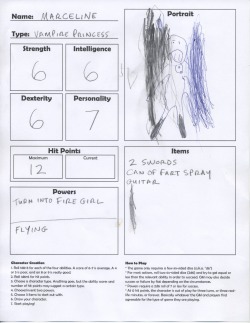
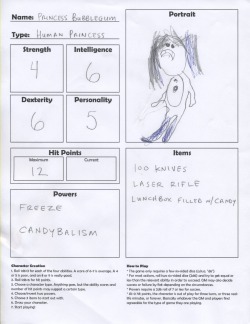
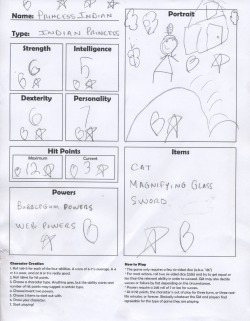
Got to play some adventures with the girls today. Rockin' good fun. It's honestly way more fun than playing with adults. Here are some of the highlights:
- The basic premise: It's been raining cats and dogs for many days. An old half-crippled wizard comes to the girls and explains that the weather fairy, who keeps the weather in order in the Land of Ooo, has been trapped by the Ice King in a giant block of ice in the middle of the spooky forest. They must rescue her!
- They encountered a mud monster, sprayed him with fart spray, and sent him floating away on a giant bubblegum bubble. He landed on the Ice King's porch with a splat. The Ice King determined he was a pile of poo (what would you think a big pile of mud soaked in fart spray was?) and had his minions hose down the porch, destroying the monster.
- On the next encounter, I rolled two story dice and got a bee and an envelope. I decided it was a giant killer bee that was also the mailman. The girls decided to pack some garbage into envelopes and mail it to the Ice King. They really enjoyed terrorizing the crap out of that guy! Even though the characters were hundreds of miles away, I played out the Ice King receiving his packages so they could get a nice payoff for their dirty tricks. There was immense laughter at the table.
- One of the players made good use of the magnifying glass item she chose at the beginning of play, closely inspecting the water in a magic fountain to ensure it wasn't harmful. Also, just for good measure, she had her cat test out the water first.
- After rescuing the weather fairy, I told them they had completed their quest. They said they wanted to go take on the Ice King anyways, to ensure that he didn't commit any more mischief. They really had it out for the guy!
- After defeating (knocking out) the Ice King in an epic battle, I asked what they wanted to do with him. Tying a large rock to him and dropping him into a volcano was discussed, but in the end they decided to jail him in the dungeons of the Candy Kingdom - with a hungry grizzly bear as his cellmate for good measure.
We all had a ton of fun, and it's really rewarding to see little kids adding up simple figures, and coming up with creative solutions to challenges. I highly recommend doing this if you have any kids around.
It just so happens that this week is also Teach Your Kids to Game Week, and while I really appreciate the spirit of it, there are a few things about it that I think could be better.
- More free games. I've purchased a number of non-free PDFs of "RPGs for kids", and they tend to suffer from a sort of identity crisis. On the one hand, if you're going to charge money for something, there should be some meat to it, with lots of material and options presented. On the other hand, if it's a game for young kids, it needs to be very simple and open-ended. So what you end up with is something that is either too complex to really be a kids' game, or something that is so simple that you feel dumb paying money for it. I certainly haven't seen every offering out there, and I'm sure there are exceptions, but this has been my overall experience with these types of games.
- More support articles with stories and tips about playing with kids. It seems like this is not much more than "here are some game PDFs". I think this is easy enough for people that are currently into RPGs, but what about the guy that hasn't played for years and wants to try it out with his kids. There should be some help available for that guy.
So now since I feel mildly uncomfortable about criticizing a thing meant to be good for kids, I hereby offer my payment of the Joesky Tax - a complete list of the resources I used to run my game today, complete with explanations and examples.
- A few printed copies of my TOON hack character sheet. Game rules included on the sheet. I believe this game to be suitable for any type of adventure gaming one might do with young kids. For any rules not listed on the sheet, make something up that is fun and reasonably fits the situation at hand. That is the key. We honestly barely even used these rules, and could probably get by without any rules at all. You will have way more fun making stuff up as you go than you would going over some list of predetermined options with a child. Don't limit them! Just go with the flow!
- A pair of six-sided dice for each player. Preferably different colors to make d66 rolls easier.
- Pencils. Dixon Ticonderoga is preferred.
- A map of the Land of Ooo. Just looking at this map gives lots of ideas for adventures. Or you could just do a google images search and easily find another suitable map.
- A magic 8-ball for answering those crazy questions kids inevitably come up with. (Thanks to Jeff Rients for this idea. I've gotten a ton of mileage out of this thing in all my games.)
- Some story dice. These are just to get your brain moving to help you make stuff up. Playing with kids is all about making stuff up. Our crusty adult imaginations need all the help they can get!
- Some random charts from the original TOON game, or any other random charts with fun things on them. I don't have anything available to share at the moment, but I'll see if I can get a few scans of some of the charts up on my tumblr in the near future as examples.
As you can see, you don't really need to buy much of anything. The story dice and the 8-ball are totally optional, and if you spend a bit of time beforehand, you can make up your own random charts or find some online. In a pinch, you could even get a little kid's ABC book and flip to a random page to give your brain a starting point. Use toys on the tabletop to play out scenarios if you like. Make up your own clever uses of stuff you have lying around to add a bit to your game. The sky is the limit really, and it's very liberating!
Finally, I think a lot of people fall victim to the idea that kids can't start playing these games until they are 8 or 10 or 12 or something. Nonsense, I say! Sure, they might not be memorizing the AD&D Weapon vs. AC To-Hit Adjustments tables, but that is a far cry from not being ready to enjoy the essential elements of tabletop adventure. Again, just forget about rules systems. Go ahead and even ditch the dice and pencils and paper. Even just a verbal exchange can be a great start.
I now leave you with these awesome character sheets.
| Character played by Penelope, age 3 |
| Character played by Bella, age 4 |
| Character played by Sophia, age 6 |
Monday, November 26, 2012
My Crappy Little NaGaDeMon Game
I whipped up this little game, which is nothing more than a hack of TOON, in the spirit of NaGaDeMon. I'm not an actual registered participant, but it seemed like a fun thing to do anyways.
I made the game so I'd have a one-stop system for any RPGish gaming I do with my daughter (age 3) and her friends (and perhaps the "grown-ups" too, when we're in the mood for some lighter fare). It should be able to handle anything from My Little Pony to Adventure Time to old-fashioned dungeon crawling. I took care to keep the thing as open-ended as possible, since I think more structured games have a stifling effect on the creativity of a child. Thus, there are no pre-defined character types, powers, or items. The players will have to make them up!
If you do happen to give it a go, I'd love to hear how it worked for you.
Linkage:
My NaGaDeMon Game 2012 (PDF)
My NaGaDeMon Game 2012 (PNG Image)
Enjoy!
I made the game so I'd have a one-stop system for any RPGish gaming I do with my daughter (age 3) and her friends (and perhaps the "grown-ups" too, when we're in the mood for some lighter fare). It should be able to handle anything from My Little Pony to Adventure Time to old-fashioned dungeon crawling. I took care to keep the thing as open-ended as possible, since I think more structured games have a stifling effect on the creativity of a child. Thus, there are no pre-defined character types, powers, or items. The players will have to make them up!
![]() |
| Yep, that's all there is to it! |
If you do happen to give it a go, I'd love to hear how it worked for you.
Linkage:
My NaGaDeMon Game 2012 (PDF)
My NaGaDeMon Game 2012 (PNG Image)
Enjoy!
Tunnels & Trolls 4th Edition PDF Released
Flying Buffalo has released a PDF of the 4th edition of the Tunnels & Trolls rules, and it is available HERE. I highly recommend the purchase, to show that there is interest in the old crusty versions. T&T 4th has a great deal of charm, and the power curve is notably lower than that of the popular 5th edition. I think it's a great framework if you want to keep your game really simple, or to have a nice skeleton upon which to build your own wacky creation. At any rate, the $4 price is tough to beat.
Subscribe to:
Posts (Atom)